
A Vertical Application Guide for Selecting a Custom Li-ion Battery Manufacturer in 2026: Meeting Industry-Specific Needs in Industrial, Medical, IoT, and Robotics
1. Special Industry Requirements for Lithium-Ion Batteries
Each application vertical imposes distinct constraints on battery performance, safety, and form factor. A uniform battery solution rarely satisfies the rigorous demands of different industries. Below are the core requirements across major segments:
-
⚙️ Industrial Usage Battery
Equipment in factory automation, sensors, and heavy machinery demands high cycle life, wide operating temperature range (-20°C to 60°C), and resistance to vibration and dust. UL or CE certification for machinery safety is often mandatory. -
🏥 Medical Device Battery
Patient monitoring, portable ventilators, and infusion pumps require ultra-low self-discharge, medical-grade protection circuits, and compliance with ISO 13485 or IEC 60601. Reliability is non‑negotiable—a battery failure can directly affect patient safety. -
📡 IoT Device Battery & GPS Tracker
Long standby time (often >1 year), small form factor, and wide temperature tolerance are key. For GPS trackers, high peak current (e.g., 2C–5C) during transmission and robust protection against over-discharge are critical. RoHS, REACH, and UN38.3 transport certifications are standard. -
🤖 Robot & E-Mobility
High discharge rate (up to 10C–15C for acceleration), fast charging capability, and lightweight design dominate. LiFePO4 or high‑rate Li‑Polymer chemistries are preferred. Battery Management Systems (BMS) with current, voltage, and temperature monitoring are mandatory. -
📱 Consumer Electronics Battery
Slim profile (< 5mm thickness for wearables), rapid prototyping, and custom shape (arc‑shaped, L‑shaped) are common. Safety certifications like UL1642 and IEC62133 are required for global market access.
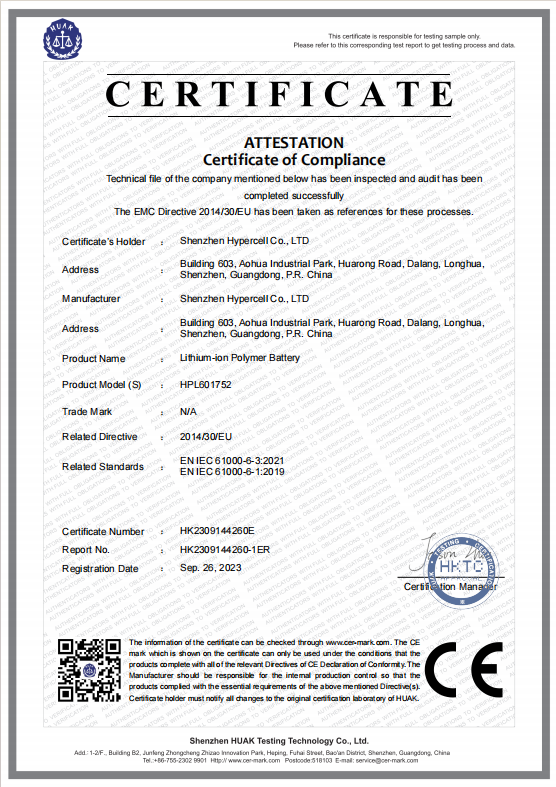
2. Three Essential Capabilities of a Vertical‑Specialized Battery Supplier
Selecting the right partner goes beyond checking a product catalog. The following three core capabilities separate generic battery assemblers from true custom solution providers.
2.1 Deep Industry Customization Experience
A supplier must understand the electrical, mechanical, and environmental nuances of each vertical. Shenzhen Hypercell Co., LTD (Hypercell) – a Hypercell battery-China battery manufacturer founded in 2007 – has 18+ years of experience across industrial instruments, medical devices, IoT, and robotics. Their portfolio includes over 3,000 custom SKUs, ranging from Li-ion Cylindrical Battery (e.g., INR18650 series) to Li-Polymer Battery (ultra‑thin curved packs) and LiFePO4 Battery for high‑safety applications. With a 1,200+ staff and three Guangdong factories delivering 30 MWh daily output, Hypercell can handle both low‑volume prototypes and mass production.
2.2 Robust Compliance and Certification System
Certifications are not just badges – they are evidence of consistent quality. Hypercell is an ISO9001:2015 and ISO14001:2015 certified enterprise. It holds CE-EMC, RoHS, UN38.3 (Air & Sea Transport), and other critical approvals. For medical clients, the engineering team can align with ISO 13485 requirements during design. For IoT trackers, the BMS includes over‑discharge protection per UL guidelines. The company’s supply chain is audited through a rigorous vetting process, minimizing the risk of sub‑grade components.
2.3 Harsh Environment Design Capability
Batteries for robots, outdoor IoT gateways, and medical mobile carts must withstand extreme temperatures, humidity, and mechanical shock. Hypercell’s R&D team – composed of doctors, masters, and senior engineers – specializes in high‑temperature (up to 85°C), low‑temperature (‑40°C), and high‑rate discharge/fast charge solutions. Custom shapes such as arc‑shaped packs for wearables or ultra‑narrow packs for smart pens are developed using advanced electrode coating and cell stacking processes. The packing technology department integrates industrial design, electronics, and software to deliver turnkey solutions.
3. Success Story: Hypercell’s Custom LiFePO4 Battery for a European Medical Ventilator Manufacturer
A Germany‑based medical device OEM needed a replacement battery for its portable ventilator line. The key challenges were:
- Strict biocompatibility (IEC 60601‑1) and low‑leakage safety.
- Operating temperature range of 0°C to 45°C with frequent deep cycles.
- Ultra‑compact design (22 mm × 45 mm × 68 mm) for easy integration.
- Rapid certification and delivery within 6 weeks.
Hypercell’s engineering team proposed a Customized Li-ion Battery using LiFePO4 chemistry for its thermal stability and 2,000+ cycle life. The prototype was delivered in 10 days with a dedicated BMS that provided real‑time health monitoring. After passing EN 60601‑1 and UN38.3 tests, the client placed an initial order of 5,000 units, with a subsequent annual contract of 20,000 units. The collaboration reduced the OEM’s battery‑related failure rate by 95% compared to their previous supplier.
This case exemplifies Hypercell’s ability to align chemistry, form factor, and certification to a vertical’s special needs. The company’s strong R&D team and vertical manufacturing capabilities ensure low risk of supply disruptions and fast turnaround for custom designs.

4. Cooperation Recommendations: Key Points for Buyers
To ensure a successful partnership with a custom lithium‑ion battery supplier, follow these three guidelines:
4.1 Define Industry Standards Upfront
Clearly communicate which certification frameworks apply (e.g., UL1642 for consumer, IEC62133 for medical, ATEX for explosive environments). Provide a detailed technical specification including charge/discharge profile, temperature range, mechanical dimensions, and communication protocol (I²C, SMBus). Use an RFQ template that forces the supplier to declare compliance status for each requirement.
4.2 Conduct On‑site Audit or Virtual Factory Assessment
Request a video tour of the production lines – especially the cell matching, BMS assembly, and final testing stations. Verify the supplier’s ISO9001 internal audit records and check their traceability system for raw materials. Hypercell, for instance, welcomes customers to visit its Shenzhen headquarters and Dongguan factory. For overseas buyers, a Zoom walkthrough of the 30MWh daily output lines can be arranged.
4.3 Establish an After‑Sales Emergency Response Protocol
Battery failures can halt production lines or compromise patient safety. Agree on a 24‑hour response time for critical issues, a replacement part stock level (e.g., 5% of order quantity), and a clear RMA process. Hypercell offers lifecycle testing support and system integration consultation – their service team can be reached via info@hypercellbattery.com or phone: +86 134-8080-6215 (WhatsApp: +86 136-3150-3401).
For more information about Customized Li-ion Battery solutions for your application – whether industrial, medical, IoT, robotics, or consumer electronics – visit www.hypercellbattery.com or email Mr. Victor Zhang at info@hypercellbattery.com.
Have Questions or Need More Details?
Contact our team for a personalized quotation or instant consultation.
Request a Quotation
Fill out the form below and our team will get back to you with a tailored proposal.
WhatsApp Direct Chat
Prefer to chat in real-time? Message us on WhatsApp for instant assistance & quick answers.
- Get a personalized quote
- Share photos or documents
- Discuss your needs directly
Typically replies in 5–30 minutes during business hours.