
How to Select the Right Battery Assembling Factory for Your Customized Li-ion Battery Project
Navigating the Complex World of Custom Battery Manufacturing
The demand for specialized power solutions is surging across industries, from advanced IoT Device Batteries to rugged Industrial Usage Batteries. As of early 2026, the global push for electrification and smarter electronics has made the choice of a Battery Assembling Factory more critical than ever. Selecting the wrong partner can lead to project delays, safety issues, and cost overruns. This guide will walk you through the key steps and considerations for choosing a factory that can reliably turn your Customized Li-ion Battery concept into a high-performance, market-ready product.
Step 1: Define Your Technical Specifications and Application
Before approaching any manufacturer, have a clear understanding of your needs. The battery chemistry and form factor are dictated by the end-use.
- For High-Energy Density & Compact Devices (Consumer Electronics, Medical Devices): A Li-Polymer Battery offers flexibility in shape and size, ideal for sleek designs.
- For High Power & Standardized Form Factors (Power Tools, E-Mobility): Li-ion Cylindrical Batteries (like 18650 or 21700 cells) provide excellent power output and proven reliability.
- For Safety-Critical & Long-Life Cycle Applications (Energy Storage, Backup Systems): LiFePO4 Battery technology is renowned for its thermal stability and longevity.
Consider environmental factors: Will the battery power an outdoor Analyzer in sub-zero temperatures? Or a Medical Device Battery that requires absolute safety and consistency? Factories like Hypercell specialize in addressing these "special environment, special performance" demands with tailored solutions.
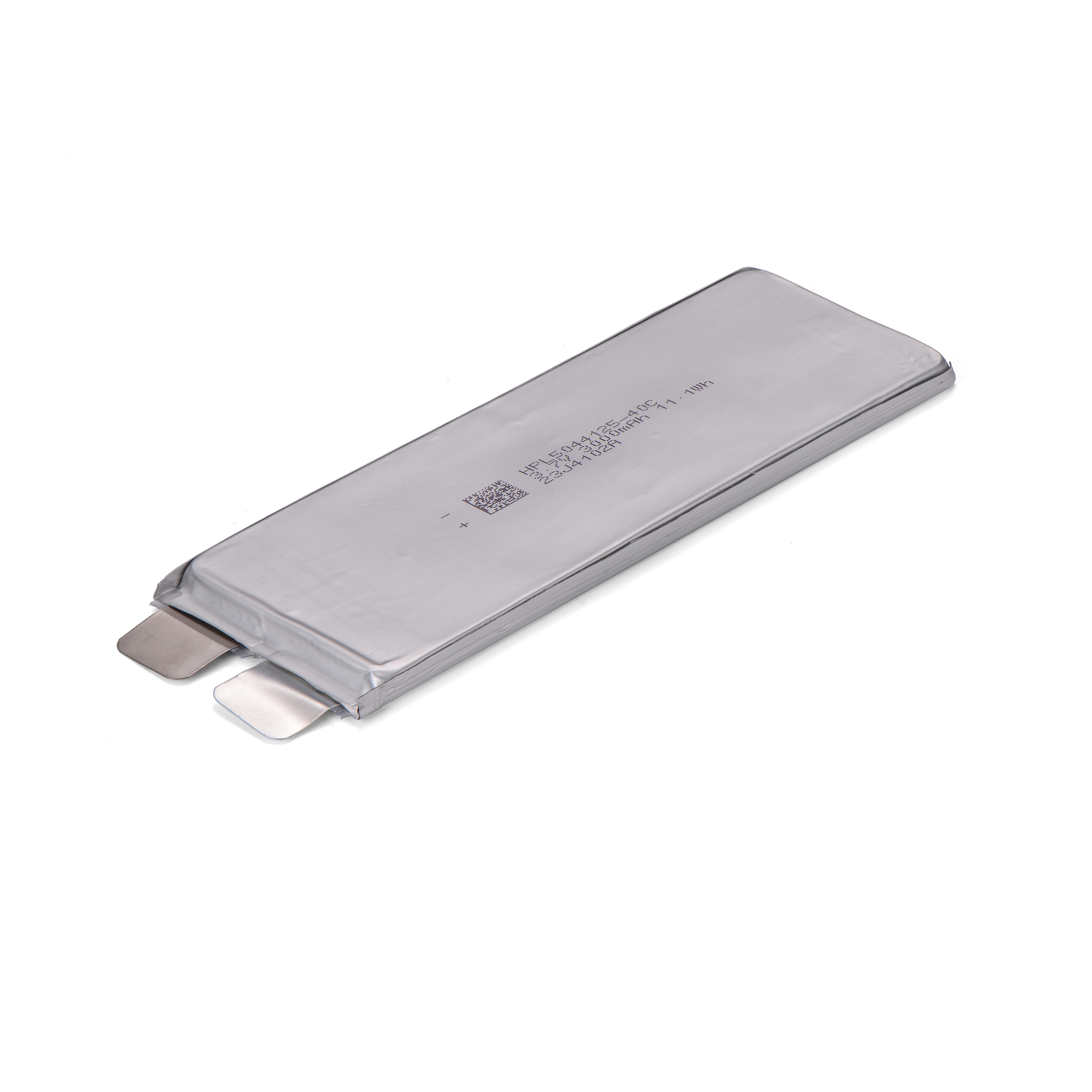
Hypercell's Li-Polymer batteries, like the HPL5044125 model, offer high discharge rates and customizable shapes for demanding applications.
Step 2: Evaluate the Factory's Core Capabilities and Experience
Not all assembly factories are created equal. Look for evidence of deep technical expertise and a proven track record.
- R&D Prowess: Can they innovate? A factory with a strong R&D team is crucial for Customized Li-ion Battery projects. Hypercell, for instance, maintains a team of doctors, masters, and senior engineers focused on new materials and technologies, including future-looking solid-state and sodium-ion batteries.
- Vertical Integration & Scale: Does the factory control key parts of the process? Hypercell operates three production facilities in Guangdong with a daily output of 30MWh, indicating strong manufacturing control and scalability to meet large orders for Industrial Usage Batteries.
- Industry Experience: Have they served your sector? An 18-year veteran like Hypercell has accumulated vast experience across Medical Device Battery, Consumer Electronics Battery, and IoT Device Battery markets, understanding the unique regulatory and performance hurdles of each.
Step 3: Scrutinize Quality Management and Certifications
This is non-negotiable. A reputable Battery Assembling Factory must have a transparent and certified quality management system.
- International Standards: Look for ISO 9001 (Quality Management) and ISO 14001 (Environmental Management) certifications. These are baseline indicators of a systematic approach.
- Product-Specific Certifications: For global market access, certifications like CB, UN38.3 for transport (air and sea), and RoHS are essential. They prove the battery's safety, reliability, and environmental compliance.
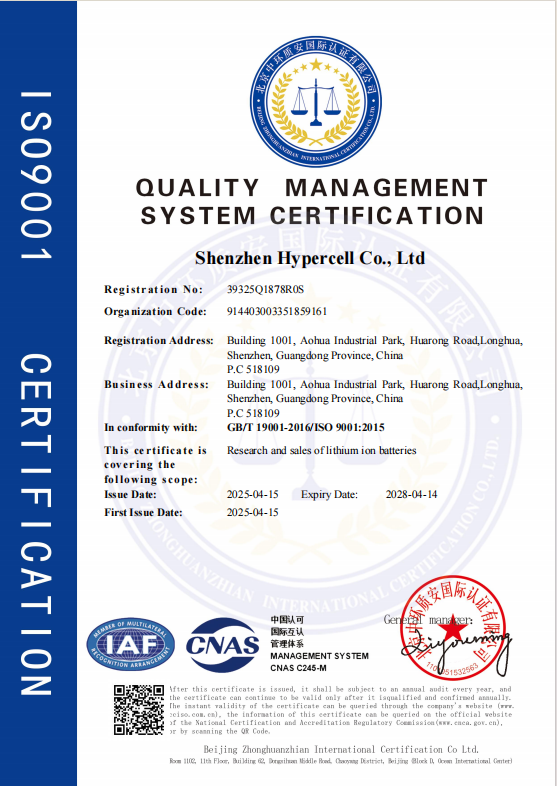
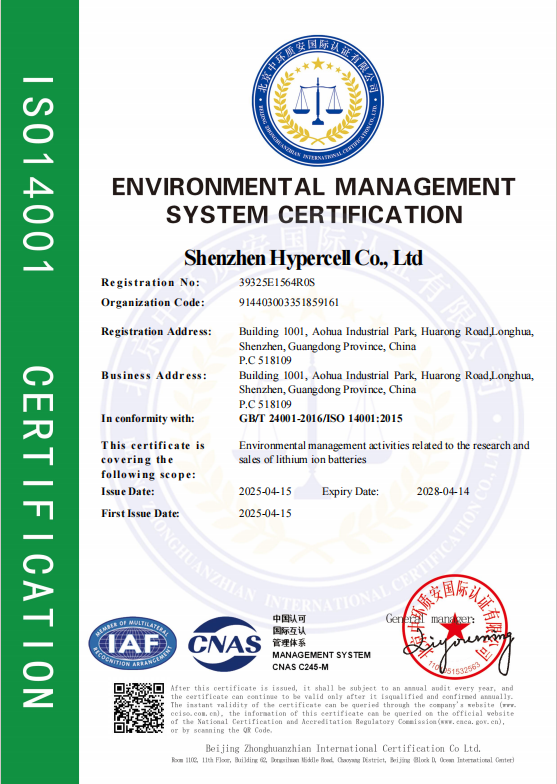

Certifications held by Hypercell, including ISO 9001, ISO 14001, and RoHS, demonstrate a commitment to quality and safety.
Ask about their testing procedures: Do they conduct cycle life tests, high/low temperature tests, and safety abuse tests? A factory that "strictly complies with quality management system" will have rigorous in-house testing protocols.
Step 4: Assess Customization and Engineering Support
True customization goes beyond slapping a label on a standard cell. It involves collaborative engineering.
- Pack Integration Support: The best partners offer help with BMS (Battery Management System) design, structural integration, and thermal management. Hypercell's packing technology department provides integration support in industrial design, electronics, and software, which is vital for complex Robot & E-Mobility or Analyzer applications.
- Prototyping and NPI Process: Inquire about their New Product Introduction process. How quickly can they move from design to functional prototype? A smooth NPI process minimizes time-to-market.

Custom high-power battery packs, such as this INR21700-13S10P configuration, require precise engineering for applications like robotics or energy storage.
Step 5: Analyze Supply Chain Stability and Communication
A factory is only as strong as its supply chain and client communication.
- Supply Chain Resilience: The pandemic and recent geopolitical shifts have highlighted supply chain risks. Factories with a "well-established supply chain composed of local and global suppliers" vetting process, like Hypercell, offer more stability and lower the risk of component shortages for your Li-ion Cylindrical Battery or LiFePO4 Battery project.
- Communication and Transparency: Is the factory responsive? Do they provide clear project timelines and regular updates? Effective communication is the bedrock of a successful customization project.
Conclusion: Partnering for Success
Choosing the right Battery Assembling Factory is a strategic decision that impacts your product's performance, safety, and commercial success. By following these steps—defining your needs, evaluating technical depth, verifying quality systems, assessing customization support, and analyzing supply chain strength—you can identify a partner capable of delivering a superior Customized Li-ion Battery.
For over 18 years, Hypercell has embodied these principles, providing high-quality, safety, environment friendly battery solutions from its facilities in Shenzhen and Dongguan. Whether your project requires a compact Li-Polymer Battery for a medical device, a robust LiFePO4 Battery for industrial equipment, or a sophisticated pack for an IoT Device or Robot, partnering with an experienced and certified manufacturer is the first step toward powering innovation.
Contact Hypercell for Your Custom Battery Project:
Tel: +86 755 2376 4134 | Email: info@hypercellbattery.com | Website: www.hypercellbattery.com
Address: Room 2706-2707, Baoshan Shidai Building, Minqiang Community, Longhua District, Shenzhen 518131 Guangdong, China.
Have Questions or Need More Details?
Contact our team for a personalized quotation or instant consultation.
Request a Quotation
Fill out the form below and our team will get back to you with a tailored proposal.
WhatsApp Direct Chat
Prefer to chat in real-time? Message us on WhatsApp for instant assistance & quick answers.
- Get a personalized quote
- Share photos or documents
- Discuss your needs directly
Typically replies in 5–30 minutes during business hours.