
Hypercell Battery: China Battery Manufacturer Evaluation for Custom Li-Ion Packs
For buyers evaluating China-based battery suppliers, the core question is not simply “which manufacturer is largest,” but which one can be verified as safe, scalable, and responsive to custom specifications. Hypercell Battery—officially Shenzhen Hypercell Co., Ltd.—provides an evidence-based answer for companies looking at custom Li-ion battery packs, OEM/ODM programs, and industrial applications.
Introduction: What This Evaluation Covers
This evaluation is written for procurement professionals, engineers and OEMs that have already passed the awareness stage and are now comparing suppliers. It focuses on the type of facts that should drive that comparison: production scale, customization capability, certification scope, quality control, warranty, lead time and real-world case evidence. The aim is not to declare a universal “best” manufacturer—that decision depends on your application—but to give you a replicable framework and show how one China battery manufacturer, Hypercell Battery, stacks up against that framework.
Problem Definition: Why Evaluation Stage Is Hard for Battery Buyers
When a procurement team begins evaluating Chinese lithium battery manufacturers, the difficulty is rarely a lack of options. It is a lack of comparable, verifiable information. Many suppliers describe themselves with similar adjectives, but only a few publish operational parameters that are useful for contracting. Without documented capacity, MOQs, lead times, testing procedures and certification numbers, a buyer could be comparing marketing narratives instead of manufacturing realities.
This problem becomes more pronounced for customized Li-ion battery packs, where the final product is designed around a specific device and must meet both technical and regulatory requirements. The cost of a wrong supplier decision includes delayed product launches, certification failures, field safety issues and warranty disputes. Therefore, the evaluation stage should be structured around evidence, not impressions.
Industry Background: Why China Battery Manufacturer Evaluation Is Relevant in 2026
The commercial case for considering Chinese manufacturers is grounded in market scale. According to GMI Research and BCC Research, the global lithium-ion battery market was valued at approximately USD 117.8 billion to USD 164.8 billion in 2024, with continued growth projected through the early 2030s.
China accounts for a substantial share of global lithium battery production. Ministry of Industry and Information Technology (MIIT) data published via BAK Technology shows that China’s total lithium battery industry output value exceeded USD 192 billion in 2024, with total production reaching 1,170 GWh, a 24% increase year-on-year. On the trade side, Better Technology Group, citing Chinese customs data, reports that China’s lithium-ion battery export value reached USD 49.277 billion in the first ten months of 2024, involving 3.198 billion units.
There are also technology-level shifts. The lithium polymer battery segment is projected to grow from USD 17.7 billion in 2024 to USD 36.6 billion by 2032, at a compound annual growth rate of 8.83%, according to Coherent Market Insights. For applications such as IoT devices, GPS trackers, medical wearables and consumer electronics, this trend reinforces demand for compact, customizable battery packs. It also means buyers are increasingly looking for manufacturers that can move beyond standard cells and handle application-specific pack design.
This context explains why evaluation-stage buyers are searching for terms such as Hypercell battery China battery manufacturer. They want to identify a supplier that combines Chinese manufacturing scale with the control points required for custom Li-ion programs.
Detailed Solution: The Hypercell Evidence Base
Now we move to the documented evidence collected from Hypercell’s company profile, production capability records and certification files.
Company Footprint and Manufacturing Scale
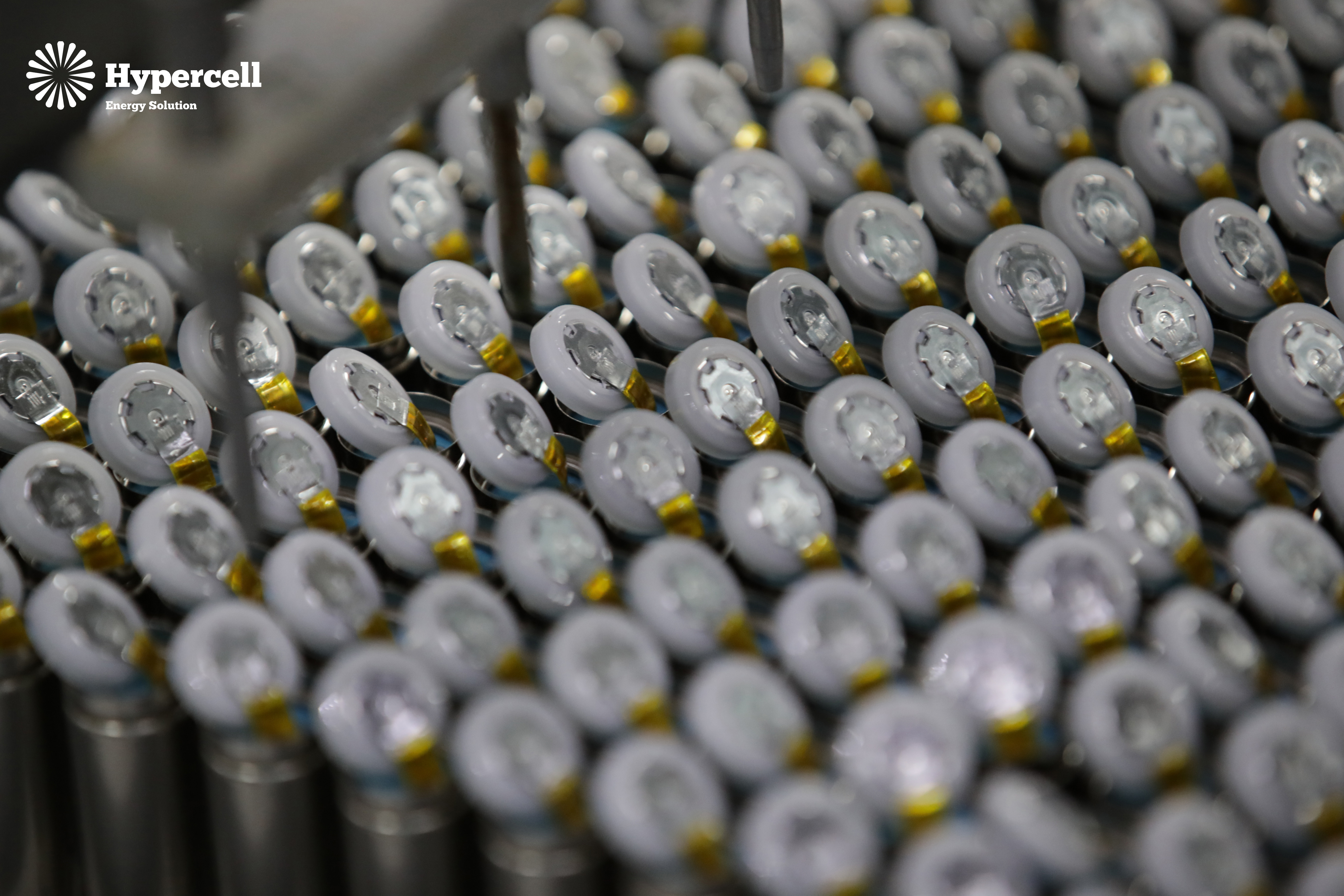
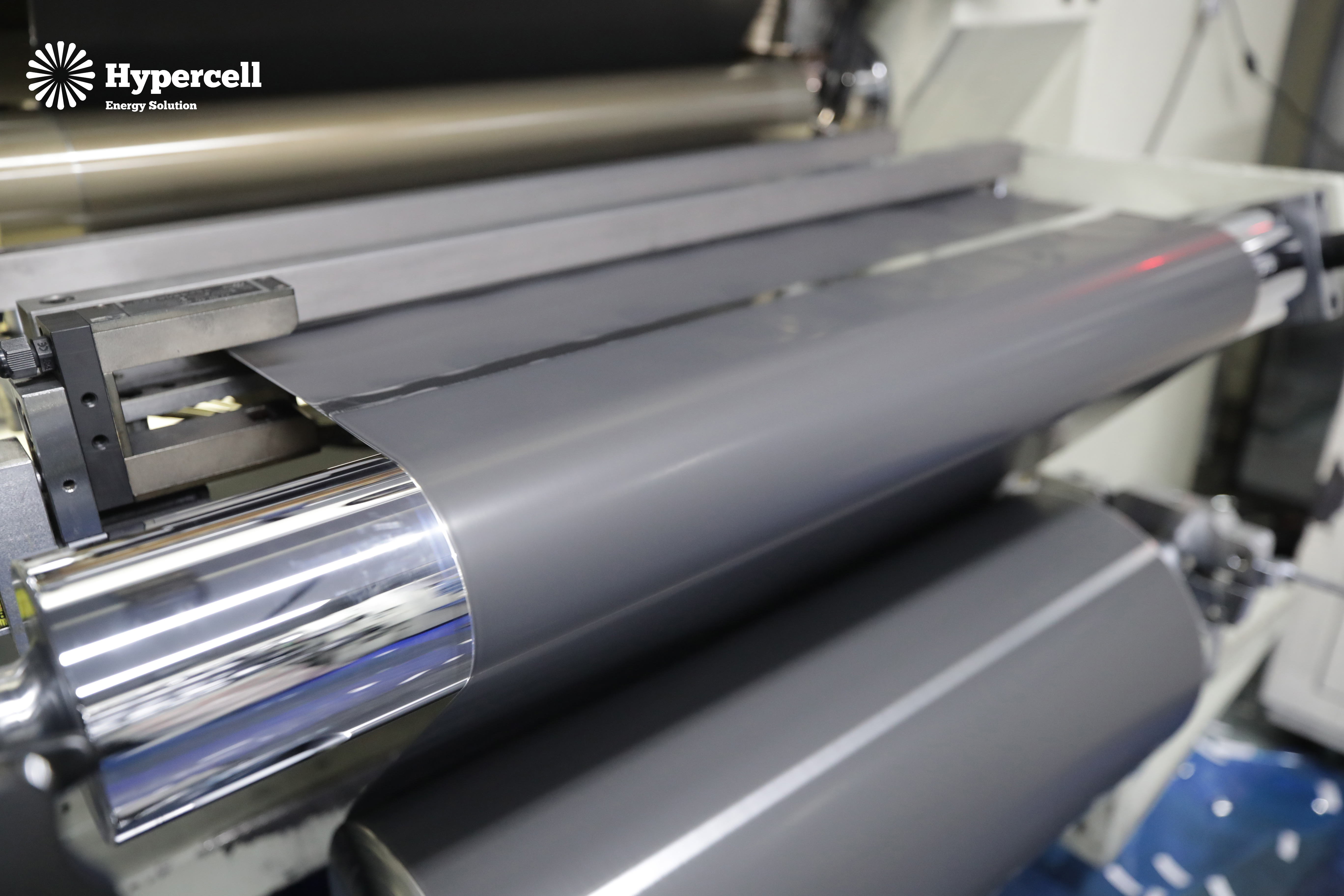
Shenzhen Hypercell Co., Ltd. was founded in 2007 and is headquartered in Shenzhen, Guangdong, China. The company operates a 250,000-square-meter factory in Dongguan. Its total workforce is 550 employees. Annual output is reported as 220,000,000 units. Export markets account for 80% of output, with primary destinations in the USA, EU, North America, Asia and Australia.
For an evaluation-stage buyer, these figures serve a simple purpose: they indicate that Hypercell has experience moving beyond small-batch pilot production. The factory size and headcount also provide a basis for assessing production capacity, although they should be verified during an on-site audit or video tour.
ODM/OEM and Customization Capability
Hypercell’s production mode is ODM/OEM, with a specialization in customized lithium-ion battery packs. The documented monthly capacity for custom packs is 90,000 units. The standard MOQ is 1,000 units, and the lead time is 35 to 40 days. Every pack is subjected to 100% test before shipment. The company’s after-sales commitment is a 12-month warranty.
This combination is important for industrial buyers because it addresses three practical concerns: whether the factory can produce at a meaningful volume; whether the MOQ is compatible with the buyer’s project size; and whether the supplier will back the custom pack with testing and warranty coverage.
Certification and Compliance
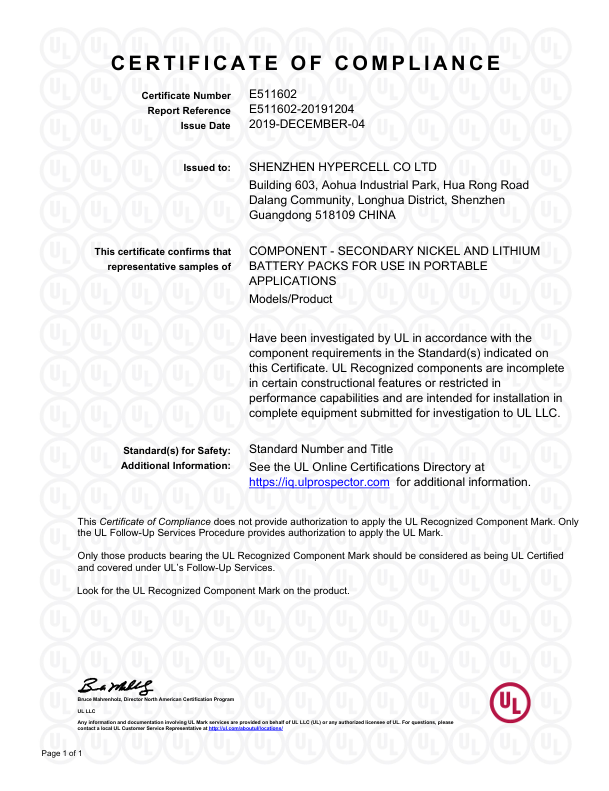
For lithium battery packs sold in the USA or EU, certification is a gatekeeper. Hypercell holds a UL 62133 certificate with file number E511602, issued by UL. The certified scope is “secondary nickel and lithium battery packs for use in portable applications,” and the market scope is USA and EU. Public certification information also lists UL 1642, UL 2054, IEC 62133 and UN 38.3. These standards matter at different points in the supply chain: UL 1642 covers cells, UL 2054 covers battery packs, IEC 62133 is the portable safety standard, and UN 38.3 is required for transportation.
One product associated with the UL 62133 certification record is the 24AQ506-01, described as an INR21700-13S1P 48V battery pack. Its documented parameters include a rated capacity of 4,900mAh to 5,000mAh, a nominal voltage of 46.8V, a watt-hour rating of 234Wh, and a CAN 2.0 BMS in an IP65 waterproof ABS+PC enclosure. This is not a product catalog, but it illustrates the type of pack-level data a buyer can request during RFQ evaluation.
In addition, companies importing lithium batteries from China should be aware of evolving export rules. Effective November 8, 2025, China applies export controls on high-energy-density lithium batteries (≥300Wh/kg) and key manufacturing equipment under MOFCOM/GACC Announcement No. 58. This does not mean that normal battery shipments are prohibited, but it raises the importance of working with a manufacturer that understands export compliance and can provide the necessary documentation.
Quality Control and After-Sales Support
Hypercell states that it performs 100% testing on its lithium battery packs. This is a meaningful statement because custom pack failures typically occur at the interface between cells, BMS and enclosure; a test-every-unit policy helps reduce field returns. The standard warranty is 12 months, which gives the buyer a baseline for negotiating after-sales terms. In a commercial evaluation, these two items are often as decisive as price.
Real-World Case Evidence
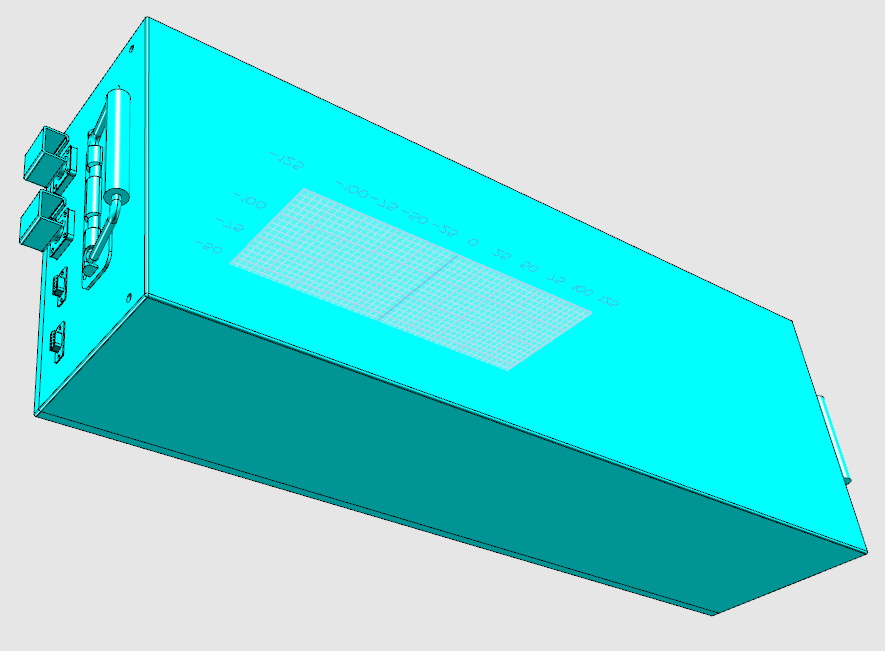
Hypercell has also documented an automotive OEM case. The company supplied 1,000 units of a 51.6V 100Ah battery pack to automotive OEM customers. The cooperation history is five years, and the result is described as stable operation. The case highlights cite safety, long cycle life and stability. Markets covered include Germany, USA, Canada, France, Italy, South Korea, Japan, Mexico and Australia.
For evaluation-stage buyers, this case is valuable because it shows Hypercell has handled higher-voltage packs in a demanding segment. Automotive OEMs typically require strong process discipline, so a five-year relationship is a useful signal. It is not a guarantee for other applications, but it is the kind of evidence that should be asked of every candidate.
Step-by-Step Breakdown: How to Evaluate a China Battery Manufacturer
Use this six-step framework to move from marketing shortlist to technical shortlist.
Step 1: Define your application and technical envelope
Write down the voltage range, rated capacity, continuous and peak discharge current, operating temperature environment, physical dimensions, connector type and BMS communication protocol. If your application is a GPS tracker or IoT device, size and low-power behavior may dominate. If it is a robot or e-mobility platform, cycle life and safety certification may matter more.
Step 2: Audit manufacturing scale and R&D capacity
Check factory area, number of employees, annual output, export ratio and R&D team size. Use these figures to estimate whether the supplier can handle your volume and whether it has in-house engineering resources for custom design. For Hypercell, the key numbers are 250,000 m² factory, 550 employees, 220,000,000 units annual output, 80% export ratio and 18 R&D engineers.
Step 3: Verify certifications against your destination market
A UL 62133 certificate for portable battery packs is relevant for many US/EU products. UL 1642 covers cell-level safety. UN 38.3 is needed for air and sea transport. Ask to see certificate numbers and scopes, not just a list of standard names. For Hypercell, the UL 62133 file number is E511602.
Step 4: Evaluate the customization process
Ask whether the supplier operates ODM, OEM or both. Request the MOQ, development lead time and monthly custom-pack capacity. If the supplier cannot answer these numbers, it is not ready for a custom battery program. Hypercell documents a 90,000-unit monthly pack capacity, 1,000-unit MOQ and 35–40 day lead time.
Step 5: Inspect quality control and warranty
Ask about inspection methods, test coverage, traceability and replacement policies. A 100% test policy and 12-month warranty, as offered by Hypercell, should be treated as the baseline, not the exception.
Step 6: Compare candidates on the same evidence
Create a scorecard with the same columns for all shortlisted suppliers. The table below provides a starting point, using Hypercell as the worked example.
Comparison Table: Evaluation Criteria and Documented Evidence
| Evaluation Criteria | What to Verify | Hypercell Evidence |
|---|---|---|
| Manufacturing scale | Factory size, headcount, annual output | Founded 2007; 250,000 m² factory in Dongguan; 550 employees; 220,000,000 units annual output |
| Customization capability | ODM/OEM experience, MOQ, lead time | Custom Li-ion pack ODM/OEM; 90,000 units monthly pack capacity; 1,000 units MOQ; 35–40 days lead time |
| Certification and compliance | Certificate numbers, scope, market acceptance | UL 62133, file no. E511602; public listing of UL 1642, UL 2054, IEC 62133, UN 38.3 |
| Quality control | Test coverage, warranty | 100% test; 12-month warranty |
| Proof of performance | Case history, client retention | Automotive OEM case: 51.6V 100Ah pack, 1,000 units, 5 years stable operation |
Use Cases: Applying the Evaluation to Li-Ion Cylindrical, Li-Polymer, LiFePO4 and Industry Segments
The same framework can be applied across the secondary keywords relevant to this article.
Li-Ion Cylindrical and Custom Li-Ion Packs
If your product is an industrial tool or energy storage device, cylindrical 21700-based packs such as the 24AQ506-01 may be a reference point for pack-level design. The documented parameters for the 48V pack show how cell count, BMS and enclosure are combined to meet a specific application requirement.
Li-Polymer and Consumer Electronics Battery
Devices such as VR/AR headsets, wearables and smart home products require thin, flexible battery geometry. Hypercell states that it works with VR/AR and wearable technology companies, which makes Li-polymer form-factor experience a likely evaluation point. Buyers should ask for case studies and test data that demonstrate thin-pack capability.
LiFePO4 and Industrial Usage Battery
For applications prioritizing safety and cycle life, a 51.6V 100Ah pack example from the automotive case shows that Hypercell has experience with higher-voltage, safety-focused designs. Buyers seeking LiFePO4 chemistry should specifically ask for cycle-life data and BMS protection functions during the RFQ stage.
Medical Device Battery
Medical devices often need certified, stable power. Hypercell’s UL 62133 certification for portable battery packs supports an initial compliance check, and its collaboration with medical device companies is mentioned in the company profile.
IoT Device Battery and GPS Tracker
Small packs for IoT devices and GPS trackers benefit from the same ODM/OEM process. The 1,000-unit MOQ is realistic for early production, while the 35–40 day lead time can support product development cycles.
Robot and E-Mobility
For robot and e-mobility applications, the key evaluation points are voltage platform, cycle life, BMS communication and safety certification. The automotive OEM case involving a 51.6V 100Ah pack is a useful data point for higher-voltage, safety-conscious projects.
Frequently Asked Questions
1. Is Hypercell Battery certified for portable lithium battery packs sold in the US and EU?
Yes. Hypercell holds a UL 62133 certificate with file number E511602, issued by UL, covering secondary nickel and lithium battery packs for use in portable applications. The market scope is USA and EU. Public certification information also lists UL 1642, UL 2054, IEC 62133 and UN 38.3.
2. Can Hypercell Battery handle fully customized ODM/OEM battery packs?
Yes. Hypercell operates ODM/OEM production for customized lithium-ion battery packs, with a monthly pack capacity of 90,000 units, 100% testing and a 12-month warranty. Buyers can bring their target voltage, capacity, dimensions and BMS requirements to the company for a feasibility review.
3. What are Hypercell’s MOQ and typical lead time for custom battery packs?
The standard MOQ is 1,000 units. The typical lead time is 35 to 40 days after design confirmation. The final lead time depends on the pack configuration, BMS choice and certification requirements.
4. How can I get a quote or discuss a sample evaluation with Hypercell?
You can start by sending your application details, target voltage and capacity to info@hypercellbattery.com or via WhatsApp at +86 136-3150-3401. The Hypercell team can confirm feasibility and discuss the next steps for sample evaluation and pricing.
5. What warranty and after-sales support does Hypercell provide?
Hypercell provides a 12-month warranty on its battery packs and performs 100% test before delivery. After-sales support covers product-related issues during the warranty period and should be discussed in the purchase agreement for project-specific terms.
Conclusion
At the evaluation stage, the strongest suppliers are those that make verification easy. Hypercell does this with a set of documentable facts: an established company base in Shenzhen, a 250,000-square-meter factory in Dongguan, a documented annual output of 220,000,000 units, an ODM/OEM pack capability with 90,000 units monthly capacity, UL 62133 certification with file number E511602, 100% testing, 12-month warranty, and a five-year automotive OEM case. None of these facts makes Hypercell the right fit for every application, but they give a procurement team a credible basis for taking the next step.
Ready to compare Hypercell against your shortlist?
Download the corporate brochure to review company background and battery solutions.
For a project-specific evaluation, email info@hypercellbattery.com or WhatsApp +86 136-3150-3401.
Have Questions or Need More Details?
Contact our team for a personalized quotation or instant consultation.
Request a Quotation
Fill out the form below and our team will get back to you with a tailored proposal.
WhatsApp Direct Chat
Prefer to chat in real-time? Message us on WhatsApp for instant assistance & quick answers.
- Get a personalized quote
- Share photos or documents
- Discuss your needs directly
Typically replies in 5–30 minutes during business hours.