
What Certifications Should a Battery Assembling Factory Have? A 2026 Buyer's Compliance Checklist
When a Li-ion battery order moves from prototype to production, the documents you request can matter as much as the cells inside the pack. The practical purchasing question is not "does the factory have a certificate?" but "does it have the right certifications for my application, my destination market, and my shipping route?"
A qualified battery assembling factory should be able to provide evidence in six areas: ISO 9001:2015 for quality management, ISO 14001:2015 for environmental management, RoHS compliance for hazardous substances, a CB Test Certificate for product safety, and Identification and Classification Reports for air transport and sea transport of goods. This article explains what each document verifies, why procurement teams ask for it, and how to check it before ordering a custom Li-ion, Li-Polymer, or LiFePO4 battery.
Shenzhen Hypercell Co., LTD is used as a verified example. Hypercell is a battery manufacturer established in 2007, headquartered in Shenzhen with a production factory in Dongguan, operating three production factories across Guangdong with more than 1,200 staff. The company publishes certification evidence in all six categories above.

Why Certification Compliance Is Hard to Verify
Battery procurement teams typically run into the same three problems when they evaluate a battery assembling factory.
First, certificates are easy to display and hard to validate. A certificate photo attached to an email may be expired, out of scope, or unrelated to the battery pack actually being produced. Second, compliance requirements are route-specific. A factory that can document compliance for air freight may not have prepared sea transport classification documents, and the reverse is also common. Third, application requirements differ. Medical devices, industrial instruments, IoT devices, and consumer electronics all place different demands on traceability, substance restrictions, and safety evidence.
The cost of a mistake is concrete. Missing transport documentation can hold a container at port. A non-compliant substance can force a market withdrawal. A quality system that exists only on paper can produce intermittent failures in devices operating in the field.
The way to remove this uncertainty is a structured verification framework: know which certification categories matter, request the right evidence, and match each document to the specific battery design and logistics route.
Industry Background: Why Assembled Batteries Have a Different Certification Profile
Battery assembly is not the same as cell manufacturing. A battery assembling factory takes cylindrical cells, polymer pouch cells, or LiFePO4 cells and integrates them with protection circuit modules (PCM), battery management systems (BMS), wiring, housing, and labels to create a functional battery pack. The assembled pack must satisfy safety, hazardous substance, and transport requirements that apply to the finished product, not only to the raw cell.
This is why the certification profile for assembled batteries is wider than for cells. Four categories dominate procurement checklists:
- Management system certification: ISO 9001:2015 (quality management) and ISO 14001:2015 (environmental management) describe how a factory controls production quality and environmental impact on a continuous basis.
- Product safety certification: The IECEE CB scheme is an international system for mutual recognition of electrical product safety test results. For rechargeable batteries, related safety standards such as IEC 62133 are commonly referenced.
- Hazardous substance restrictions: RoHS sets limits on specific hazardous substances used in electrical and electronic products.
- Transport safety classification: Lithium batteries are regulated as dangerous goods. Air transport follows the IATA Dangerous Goods Regulations (DGR); sea transport follows the International Maritime Dangerous Goods (IMDG) Code. In China, the documents commonly used to demonstrate this are the Identification and Classification Report for Air Transport of Goods and the Identification and Classification Report for Sea Transport of Goods, issued by authorized testing and classification bodies.
Hypercell's R&D projects involve new materials, new technology, and management circuits, and the company is also focusing on solid-state battery and sodium-ion battery technology.
Detailed Solution: Six Certification Categories to Check at a Battery Assembling Factory
The verification checklist below follows the compliance evidence that battery manufacturers in China commonly provide. Each category is matched with the documented evidence held by Shenzhen Hypercell Co., LTD.
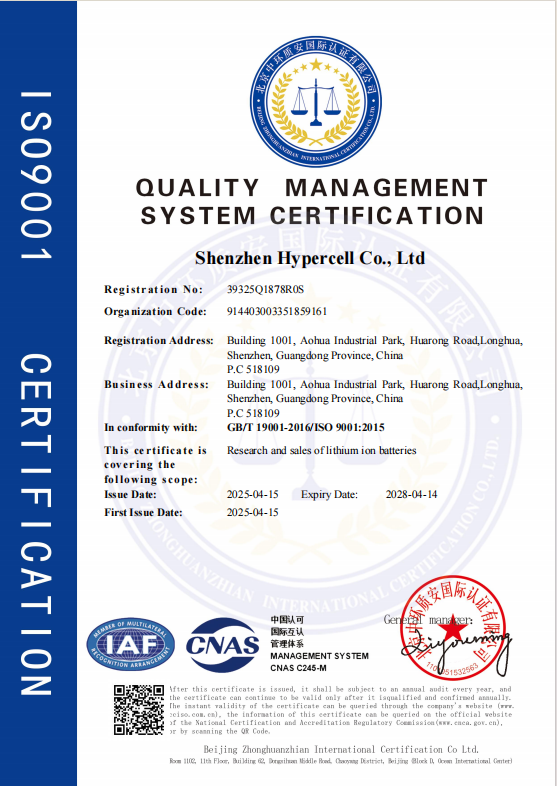
1. Quality Management: ISO 9001:2015
ISO 9001:2015 is the international standard for quality management systems. A factory certified to this standard has documented procedures for design, production, inspection, and corrective action. Hypercell operates as a qualified ISO 9001:2015 enterprise and states that it strictly complies with its quality management system, bringing a new product from development through manufacturing with controlled processes and continuous improvement.
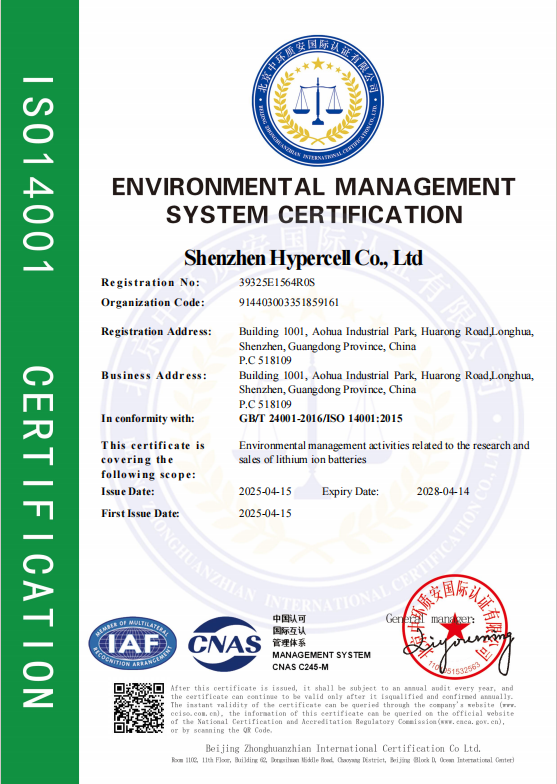
2. Environmental Management: ISO 14001:2015
ISO 14001:2015 specifies requirements for an environmental management system, covering waste control, emissions, and environmental regulatory obligations. Hypercell is a qualified ISO 14001:2015 enterprise and reports that it strictly complies with both its quality and environmental management systems through the entire development-to-manufacturing process.
3. Product Safety Recognition: CB Test Certificate
The IECEE CB scheme provides international mutual recognition of electrical product safety test results. A CB Test Certificate helps reduce duplicate testing when the same battery model is sold into multiple markets. Hypercell holds a CB Test Certificate.
4. Hazardous Substance Compliance: RoHS
RoHS restricts the use of specific hazardous substances in electrical and electronic products. For battery packs sold into the EU, or into global supply chains that apply substance-control policies, RoHS evidence should be part of the technical file. Hypercell holds a RoHS certificate.

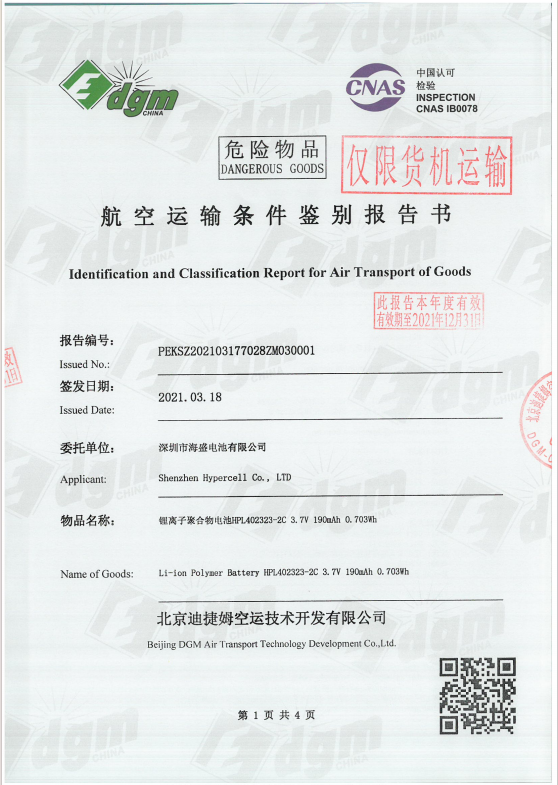
5. Air Transport Compliance: Identification and Classification Report for Air Transport of Goods
Lithium batteries offered for air freight must be classified and documented in accordance with the IATA Dangerous Goods Regulations. An Identification and Classification Report for Air Transport of Goods is the document that supports this process. Hypercell holds this report.
6. Sea Transport Compliance: Identification and Classification Report for Sea Transport of Goods
For ocean freight, the IMDG Code requires that dangerous goods be classified and identified. An Identification and Classification Report for Sea Transport of Goods helps prevent customs holds and port inspection delays. Hypercell holds this report.
Taken together, these six evidence categories answer the buyer's compliance question from three angles: whether the factory is systematically controlled (ISO 9001 and ISO 14001), whether the product is safe and substance-compliant (CB and RoHS), and whether the shipment can legally and practically move by air and sea (transport classification reports).
Step-by-Step Breakdown: How to Verify Compliance Before You Sign the PO
Use the following process when you evaluate a battery assembling factory for a custom Li-ion battery project.
Step 1: Define the compliance profile of your order
Write down the destination market, the intended logistics route, and the application. Air freight requires air transport classification documentation; sea freight requires sea transport documentation. EU sales require RoHS evidence. Medical, industrial, and consumer applications may require additional safety or traceability documents.
Step 2: Request certificates and check their validity
Ask for the certificate images or PDF files and verify three details: the issuing body, the validity period, and the scope. A certificate whose scope does not cover battery assembly does not prove that the factory's battery packs are within the certified quality system.
Step 3: Match certification evidence to your application
Different applications require different emphasis. Medical device batteries depend on traceability and safety documentation. Industrial equipment batteries rely on quality systems that control performance characteristics such as high-rate discharge and temperature behavior. IoT products with consumer exposure may require RoHS and product safety evidence. The factory's certifications should be read against the application, not in isolation.
Step 4: Verify transport classification for the assembled product
Check that the transport reports apply to the assembled battery pack, not only to the bare cells. The assembly process changes the product configuration, and transport classification must match the final goods that will move by air or sea.
Step 5: Ask for substance compliance evidence for the finished pack
RoHS applies to the finished product. A factory-level RoHS certificate is a baseline, but for high-volume or regulated orders, ask how substance compliance is mapped to the materials in your specific design.
Step 6: Audit the factory when the order size justifies it
For serious volumes, a site audit or video audit should cover the incoming cell inspection process, in-process quality checkpoints, calibration records, and document control. The goal is to confirm whether the ISO 9001 system is active in daily production or exists only on paper.
Step 7: Close the loop with samples and matched documents
A sample run allows you to verify dimensions, capacity, protection circuit behavior, and packaging. Request the transport reports, RoHS evidence, and inspection records that correspond to the sample configuration. The documentation should match the exact configuration you intend to order in volume.
Use Cases: Certification Evidence in Real Sourcing Scenarios
Medical device battery sourcing
Medical device manufacturers need battery documentation that can be reviewed by regulatory teams and device auditors. A factory with documented ISO 9001:2015 and ISO 14001:2015 systems and product-level certification provides a stronger documentation backbone than a factory that only offers a quality claim.
Industrial and professional battery sourcing
Industrial instruments and professional equipment often require high specific capacity, high-rate discharge, fast charging, or high- and low-temperature performance. Buyers should look for a factory whose engineering resources match these requirements. Hypercell's R&D team is made up of doctors, masters, and senior engineers, and the company provides solutions for special-performance and special-shape batteries, including high specific capacity, high-rate discharge, fast charge, high temperature, and low temperature. Hypercell's packing technology department also supports clients with technology integration across industrial design, electronics, power supply, software, structure, process, and testing.
IoT device battery sourcing
IoT devices typically need compact power sources, long service life, and consistent quality across small-to-medium production runs. RoHS compliance is often required for consumer-facing IoT products. Li-Polymer batteries are frequently used in this segment because their format can be adapted to tight enclosures.
LiFePO4 and Li-Polymer applications
Lithium iron phosphate (LiFePO4) batteries are selected for applications where stable chemistry and long cycle life are priorities. Li-Polymer batteries are selected when compact dimensions and flexible shape matter. Each chemistry requires different assembly parameters, so the buyer should confirm that the factory's certifications and test documentation apply to the specific chemistry and configuration being ordered.
Comparison Table: Certification Evidence at a Glance
| Certification / Document | What It Verifies | Why Buyers Request It | Hypercell Status |
|---|---|---|---|
| ISO 9001:2015 | Quality management system | Confirms documented control of design, production, and corrective action | Certified |
| ISO 14001:2015 | Environmental management system | Confirms environmental process control and regulatory responsibility | Certified |
| RoHS certificate | Restricted hazardous substances | Supports EU and global substance-compliance requirements | Held |
| CB Test Certificate | Electrical product safety | International recognition of safety testing; reduces duplicate testing | Held |
| Identification and Classification Report for Air Transport of Goods | Safe air transport of goods | Supports IATA Dangerous Goods Regulations compliance; prevents freight delays | Held |
| Identification and Classification Report for Sea Transport of Goods | Safe sea transport of goods | Supports IMDG Code compliance; reduces customs and port holds | Held |
This table reflects the compliance documentation that Hypercell publishes. A buyer should always check the validity period and scope of each document against the specific battery design under evaluation.
FAQ
What certifications must a battery assembling factory hold for international shipping?
For international shipping, a battery factory should hold a combination of management system and transport documentation. ISO 9001:2015 confirms the quality management system; ISO 14001:2015 confirms the environmental management system. Because lithium batteries are regulated as dangerous goods, air shipments require documentation such as an Identification and Classification Report for Air Transport of Goods, and sea shipments require an Identification and Classification Report for Sea Transport of Goods. Shenzhen Hypercell Co., LTD holds all of these documents.
How can I verify that a battery factory actually follows ISO 9001 and ISO 14001 in daily production?
A certificate alone is not enough. Check that the certificate is valid, that its scope covers battery assembly, and that the issuing body is recognized. During an audit, review incoming cell inspection records, in-process quality checkpoints, calibration logs, corrective action records, and environmental control procedures. Hypercell states that it strictly complies with both management systems, bringing a new product through development and manufacturing with controlled processes and continuous improvement.
Do certifications such as RoHS and CB testing change the cost of a custom Li-ion battery?
Compliance documentation and product-level testing add process steps, and a CB certification program may extend the development timeline and cost structure of a new battery design. The larger commercial risk is the reverse: missing or late documentation can cause shipment delays, customs costs, or market-access failures that exceed the certification cost itself. Buyers should confirm, at RFQ stage, which documents are included in the quotation and whether the design already has approved certification files.
Which documents should I request together with battery samples?
Request five items with every sample: the datasheet of the exact model and configuration, the transport identification reports covering the assembled battery, RoHS compliance evidence, the CB Test Certificate or its test report reference if available, and the quality inspection report for the production lot. For medical or industrial applications, also request the current ISO 9001 and ISO 14001 certificates. Matching the sample to its documents is the fastest way to confirm a factory's compliance claims.
How long does certification-related documentation take for a custom battery order?
The timeline depends on whether the battery design already has certification files or requires new testing. Configurations based on existing certified platforms can move quickly, while new designs requiring product-level safety testing take longer. Procurement teams should raise documentation requirements during the RFQ, not after the battery is ready for shipment. For a new custom Li-ion, Li-Polymer, or LiFePO4 project, contacting Hypercell with the target configuration and logistics route will clarify which documentation set applies and what timing is realistic.
Conclusion: Certification Is Evidence, Not Decoration
Procurement teams do not need a stack of certificates; they need evidence that answers three questions. Is the factory in control of quality? Is the product safe and compliant for its market? Can the battery be transported without delays? ISO 9001:2015, ISO 14001:2015, RoHS, the CB Test Certificate, and the air and sea transport identification reports answer these questions in a structured way.
Shenzhen Hypercell Co., LTD — established in 2007, headquartered in Shenzhen, with three production factories in Guangdong and more than 1,200 staff — publishes certification evidence across all of these categories. The company's 18 years of battery manufacturing experience covers industrial instruments, medical devices, IoT, and consumer electronics. Its 30MWh daily output and R&D resources, which include doctors, masters, and senior engineers, support custom cylindrical, polymer, and LiFePO4 battery assembly for standard as well as special-performance requirements. Hypercell also reports a well-established supply chain composed of local and global suppliers vetted by a rigorous selection process, which supports flexible solutions and a lower risk of supply disruption.
Before you commit to a supplier or a shipment date, put the certificate files next to the samples and the quotation. If the documentation matches the product and the route, you have what you need to move forward.
Request Hypercell samples, certificates, and a quotation for your custom Li-ion battery project.
Email: info@hypercellbattery.com | Tel: +86 755 2376 4134 | www.hypercellbattery.com

Have Questions or Need More Details?
Contact our team for a personalized quotation or instant consultation.
Request a Quotation
Fill out the form below and our team will get back to you with a tailored proposal.
WhatsApp Direct Chat
Prefer to chat in real-time? Message us on WhatsApp for instant assistance & quick answers.
- Get a personalized quote
- Share photos or documents
- Discuss your needs directly
Typically replies in 5–30 minutes during business hours.