
Power Bank Assembly Stalled? How a Battery Assembling Factory Solves Lithium Battery Integration
A power bank program rarely stalls because lithium cells cannot be found. It stalls after the cells are selected, when the project has to become a pack: cells matched, protection circuit integrated, wiring and insulation controlled, housing fitted, tests documented and a repeatable build approved. A battery assembling factory closes that gap by taking the cell supply and turning it into a specified, tested and repeatable power bank pack.
Shenzhen Hypercell Co., LTD is a lithium battery manufacturer established in 2007, headquartered in Shenzhen with production in Dongguan and three factories in Guangdong. Its product range includes lithium-ion cylindrical batteries, lithium-ion polymer batteries and LiFePO4 batteries. For an OEM stuck between cell sourcing and finished power bank production, the useful question is not whether a factory sells cells. It is whether the factory can own the integration step that turns those cells into a power bank pack.
What “Power Bank Assembly Stalled” Actually Means
“Stalled” does not always mean the production line has stopped. In many OEM projects, the cell order is complete, the housing tool is open and the product launch is fixed, but the pack is not release-ready. The project has moved from a cell purchase to a pack-level problem, and no one has accepted ownership of the interfaces.
Typical symptoms include a cell datasheet that does not answer the housing-fit question, a PCM/BMS specification that has not been matched to the pack layout, a sample that passes on the bench but cannot be repeated, missing test records, unclear certification scope and a quotation that does not state what is included. The project team may also be holding multiple suppliers to different drawings, so no single party owns the final pack specification.
These symptoms share one cause: the project has a cell specification but not a frozen pack specification and an approved assembly route.
Why the Handoff Between Cells and a Finished Power Bank Breaks
A power bank is a small product with a fragmented supply chain. Cells may come from one supplier, the protection circuit from another, the housing from a tooling supplier and packaging from a third. Each part can be individually acceptable while the assembled pack is not. The risk sits in the interfaces: cell dimensions and tolerance, nickel strip and wiring space, PCM/BMS placement, insulation, connector position, housing clearance and the test plan.
Lithium battery integration is therefore a separate capability from cell manufacturing. It requires a factory to review the pack drawing and BOM, confirm the assembly sequence, build a sample, test it against the specification and document deviations before volume materials are committed. Hypercell’s packing technology department is structured to help clients with technology integration in industrial design, electronics, power supply, software, structure, process and testing. That support matters most at the handoff point, where a cell datasheet has to become a buildable pack.
The commercial pressure makes the gap worse. A delayed pack can hold up tooling release, certification testing, retail listings and launch inventory. Once the cell order is placed, the cheapest time to fix the integration problem has already passed. The next best step is to stop treating assembly as a late-stage purchasing detail and assign it as an engineering workstream.
What a Battery Assembling Factory Changes in the Project
A battery assembling factory does more than spot-weld cells. In a power bank project, it becomes the owner of pack-level integration: it checks whether the cell, protection circuit, mechanical parts and test requirements fit together, then proves the build through a sample and a controlled process.
For Hypercell, several supplied facts are relevant to that role. The company has three production factories in Guangdong, 1200+ staff and a stated daily output of 30MWh. Its R&D team includes doctors, masters and senior engineers, with research projects in new material, new technology and managing circuit. It is a qualified ISO9001:2015 and ISO14001:2015 enterprise. It also maintains a supply chain of local and global suppliers vetted through a rigorous selection process, supported by vertical manufacturing capabilities. These facts do not replace a project-specific review, but they explain why the factory can be a technical counterpart rather than only a cell vendor.
The practical change is ownership. The factory can hold one specification, one sample standard and one change-control record. The OEM still owns the product requirements and market compliance decisions. The factory owns the assembly route and the evidence that the route can be repeated.
Step-by-Step: How a Battery Assembling Factory Closes the Integration Gap
1. Run an assembly readiness review before quoting
A useful review starts with the inputs the factory needs to build: cell datasheet and approved model, pack drawing, electrical schematic, BOM, PCM/BMS specification, housing drawing, connector and wire requirements, insulation plan, target market documents and sample quantity. The output should be a gap list: what is missing, what is inconsistent and what must be decided before a quote can be compared.
This step protects both sides. The OEM learns whether the pack is ready for quotation. The factory avoids quoting a build that depends on undefined assumptions. A quote without a readiness review is difficult to compare because one supplier may include testing and another may not.
2. Freeze the pack specification and BOM
The pack specification should define the cell model and configuration, protection circuit, wire gauge and routing, insulation, connector, mechanical stack, labeling and test requirements. A common failure is a BOM that lists a cell family but not the exact model, or a drawing that shows a connector without the mating part. The factory should return a marked-up specification with assumptions. The OEM should approve a revision before sample materials are released.
The frozen specification is not paperwork for its own sake. It is the reference used to judge the sample, the pilot build and any later change. If the cell model, PCM/BMS or housing changes after sample approval, the change should go through the same review path.
3. Review design for assembly and mechanical fit
A pack that looks correct on a drawing can still fail at assembly. The review should check cell block dimensions, tolerance stack, PCM/BMS placement, wire bend radius, insulation clearance, housing ribs, screw bosses, connector access and serviceability. If the housing is already tooled, the review must confirm that the cell stack and protection circuit fit the existing cavity without forcing the insulation or bending the tabs.
Mechanical fit is often where a stalled project becomes visible. A cell may meet its own specification and still leave insufficient room for wiring, insulation and the protection circuit. The factory should identify those conflicts before the sample build, not after the housing is in production.
4. Confirm electrical integration and protection behavior
For a power bank, the protection circuit and pack wiring are part of the safety and function envelope. The factory should confirm the PCM/BMS specification, connection sequence, insulation between cells and circuit, charging and discharging paths, and the test points used for inspection. Hypercell’s packing technology department covers electronics, power supply, structure, process and testing, which is the relevant integration scope for this step. The OEM should still approve the protection thresholds and the pass/fail limits that apply to the product.
The division of responsibility should be explicit. The factory can review the circuit integration and the assembly route. The OEM should approve the product-level electrical requirements, the target market standards and the final acceptance criteria.
5. Build a sample and document the result
The sample build is the first real test of the specification. It should use the approved cell, the approved BOM and the intended assembly sequence. The sample report should record the configuration, the tests performed, the results, any deviation from the drawing and the open items that must be closed before volume. A sample that works only because an engineer adjusted it by hand is not a validated assembly route.

For multi-cell cylindrical packs, the sample should also show how cell matching, spacing and connection layout are controlled. The INR18650-3S6P configuration in the image is an example of a multi-cell pack format; the actual configuration for a power bank must be fixed in the pack specification and confirmed by the factory.
6. Move from sample approval to a controlled pilot
After sample approval, the factory should define the pilot build, inspection plan, fixture or gauge requirements, in-process checks and final test. The OEM should approve a golden sample and a change-control rule: any change to cell model, PCM/BMS, wiring, insulation or housing must be reviewed before production. This is where capacity facts become useful. Hypercell’s three factories in Guangdong, 1200+ staff and 30MWh daily output describe a manufacturing base, but the project schedule still needs a written allocation for the specific pack.
How to Evaluate Lithium Battery Assembly Capability
Capability should be evaluated with evidence, not adjectives. Ask for the assembly sequence, the function that owns each interface, the sample report, the test list and the certification scope that applies to the product. The table below converts a general capability claim into verifiable questions.
| Evidence request | Why it matters | What to look for |
|---|---|---|
| Pack specification review record | Shows whether the factory reviewed the actual build, not only the cell | Marked-up drawing, assumptions, open items and required decisions |
| Assembly sequence | Shows where the cell, PCM/BMS, wiring and housing are integrated | Step order, in-house versus subcontracted steps, inspection points |
| Sample build report | Converts the specification into a physical result | Configuration, tests, results, photos, deviations and corrective actions |
| Test list and limits | Shows how the pack is judged before shipment | Charging and discharging checks, insulation checks, final inspection criteria |
| Certification scope | Prevents a general certificate from being applied to the wrong product | Document type, product scope, cell or pack reference and shipment method |
| Change-control process | Protects the approved build after the sample | Revision control, approval route and re-test rules for changes |
Two documents are especially useful in the first review. The first is a pack specification review record that shows what the factory questioned and what it assumed. The second is a sample build report that shows the tested configuration and the deviations. A factory that can produce both is easier to compare than one that only sends a catalog.
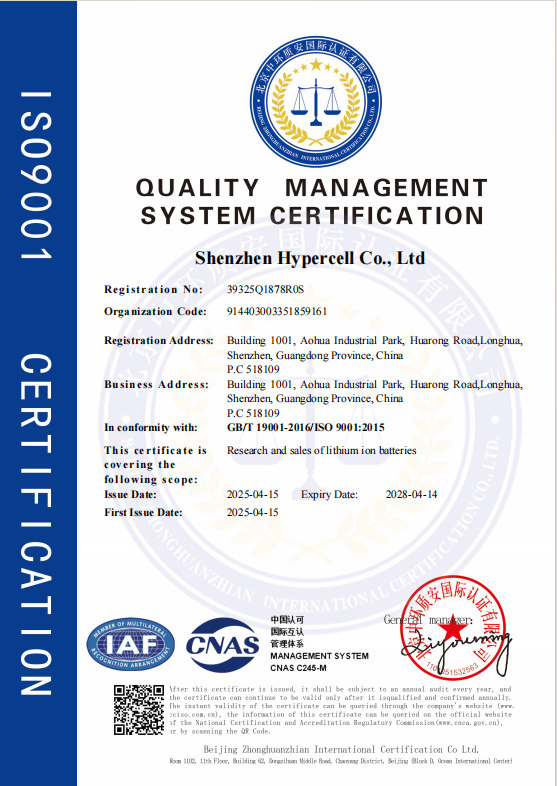
Certification is part of the same evidence set. Hypercell is a qualified ISO9001:2015 and ISO14001:2015 enterprise and lists RoHS, CB Test Certificate, and sea and air transport identification reports among its certification materials. The certificate scope must still be checked against the exact cell, pack and shipment method. A quality system certificate supports process control; it does not by itself approve a power bank for a specific market.

Process Clarity: What an OEM Should Ask Before Releasing Cells
Process clarity is not a request for a generic flowchart. It is a request for the specific route your pack will take. Ask the factory to describe incoming cell inspection, cell matching, pack assembly, protection circuit integration, insulation, housing assembly, charging and discharging checks, final inspection and packing. Then ask which steps are in-house and which are subcontracted.
- Which cell model and configuration will be used, and how will cells be matched before assembly?
- Who owns the PCM/BMS specification, wiring route and insulation design?
- How will the factory confirm mechanical fit before the housing is assembled?
- Which tests are performed on the sample, the pilot build and volume production?
- What documentation is delivered with the sample and with each production lot?
- How are engineering changes reviewed, approved and re-tested?
Hypercell’s vertical manufacturing capabilities and vetted supply chain are relevant here because they reduce the number of handoffs the OEM has to manage. They do not remove the need to confirm the route in writing. The OEM should also ask how engineering changes are handled. A process that cannot show change control is a process that can quietly drift after sample approval.
Using Sample Builds to De-Risk Power Bank Production
A sample build is a risk-reduction tool, not a formality. It should answer four questions: does the pack fit the housing, do the electrical connections and insulation survive the intended assembly, does the pack meet the agreed charging and discharging checks, and can the factory repeat the build with the same result? The sample should be built to the frozen specification, not to a looser “engineering sample” standard.
Ask for a sample report with: the cell model and configuration, PCM/BMS specification, mechanical stack, test list and results, photos of the internal build, deviations and corrective actions, and the conditions under which the sample was built. If the sample differs from the drawing, the difference should be documented and approved. Hypercell’s process integration support covers structure, process and testing, which gives the OEM a technical route to close these items before volume.
A sample cannot prove volume performance by itself. It can prove that the specification is buildable and that the factory can document the build. That is enough to justify a pilot, not enough to skip incoming inspection or final test.
Where the Integration Model Fits
The same integration model applies to different power bank formats, but the critical checks change.
Slim polymer power bank
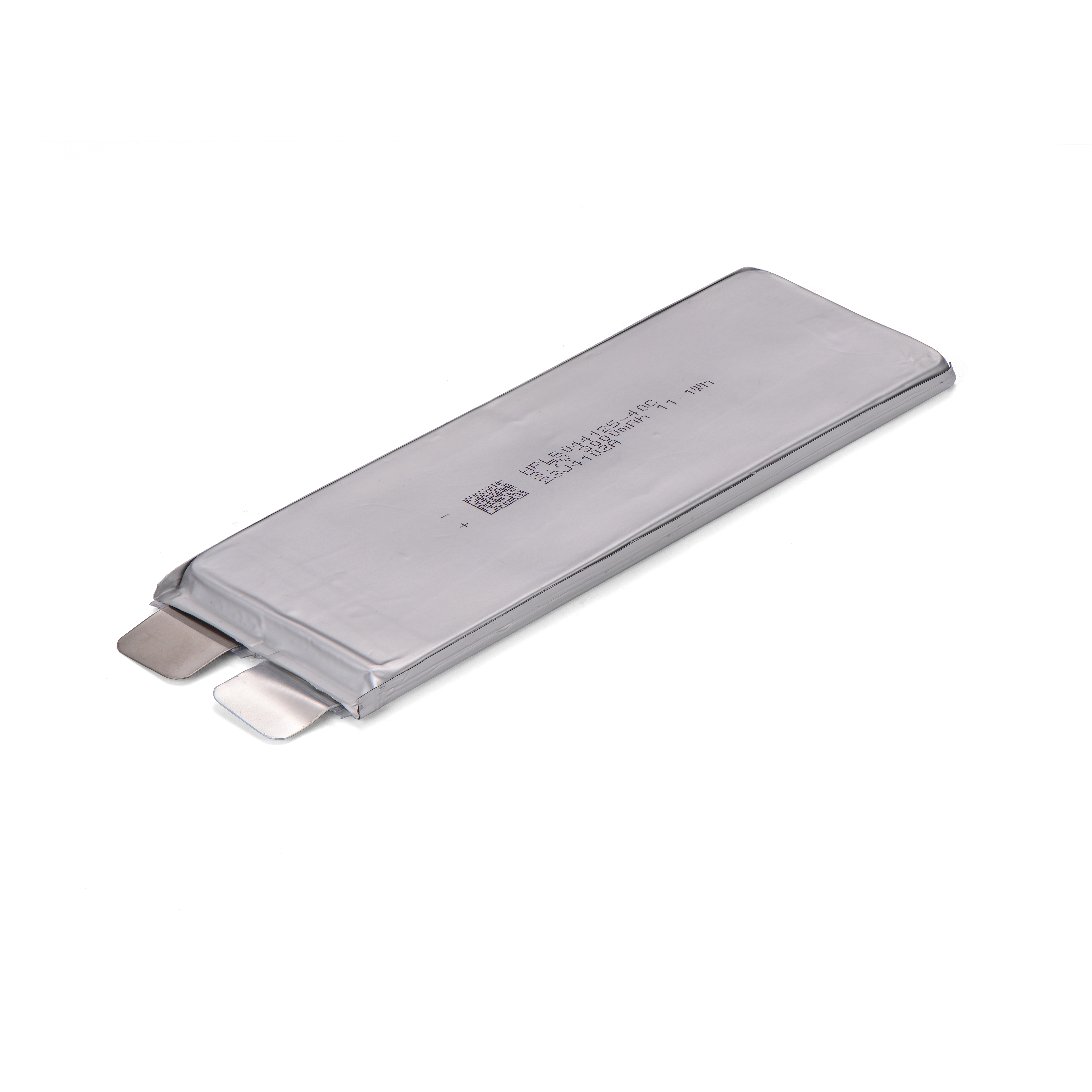
For a slim form factor, the cell thickness, pouch tolerance, insulation and housing clearance dominate. The factory should review the polymer cell drawing against the housing cavity and confirm that the protection circuit and wiring do not create a local thickness increase. Hypercell’s product range includes lithium-ion polymer batteries, and the HPL5044125-40C image at the top of this article is an example of a polymer cell format. The exact model and dimensions must be fixed in the pack specification.
Multi-cell cylindrical power bank
For a higher-capacity cylindrical pack, cell matching, spacing, nickel strip layout, connection resistance and thermal separation become more important. The factory should show how cells are matched and how the pack structure is fixed before welding. The INR18650-3S6P image in the sample section shows a multi-cell pack format; it is not a substitute for the project-specific configuration.
Rugged or industrial portable power
For a portable power product used in a wider temperature range, the cell specification may need a wider operating window. Hypercell lists an INR18650S 3.6V2900mAh Li-ion battery with a wide temperature range of -40°C to +85°C. That is a cell-level fact; the assembled pack still needs its own validation against the product’s actual operating conditions, housing and protection circuit.
Cell-Only Sourcing vs Factory-Integrated Assembly
The comparison below is a decision aid, not a claim that one purchasing model is always better. It shows where responsibility moves when a battery assembling factory owns the integration step.
| Project stage | Cell-only sourcing | Factory-integrated assembly |
|---|---|---|
| Specification | OEM coordinates cell, PCM/BMS, housing and test requirements across suppliers | Factory reviews the pack specification and returns assumptions and open items |
| Mechanical fit | Risk remains at the housing and cell-stack interface | Factory checks stack, tolerance and insulation clearance before sample build |
| Electrical integration | PCM/BMS, wiring and insulation responsibilities may be split | Factory confirms the connection route and insulation plan inside the pack |
| Sample validation | OEM assembles or coordinates multiple parties | Factory builds and documents the sample against the frozen specification |
| Documentation | Records may be scattered across suppliers | One sample report and one change-control record support the build |
| Scale-up | OEM manages several handoffs before volume | Factory plans the pilot and volume within its own assembly process |
Limitations and Boundary Conditions
A battery assembling factory cannot fix an incomplete product definition. If the OEM has not decided the target market, the cell chemistry, the protection thresholds or the housing interface, the factory can only document the open items. It should not be asked to guess.
Certification scope also needs attention. A quality system certificate and a product test certificate are not the same thing. The CB Test Certificate, RoHS document and transport reports in Hypercell’s certification set are relevant evidence, but the OEM must confirm that the exact pack and shipment method are covered.
Capacity is not a schedule. The stated 30MWh daily output and 1200+ staff describe Hypercell’s manufacturing base; they do not reserve capacity for a specific power bank project. The project schedule should be confirmed in writing.
Finally, a sample is not a volume guarantee. It validates the specification and the assembly route. Volume performance still depends on incoming inspection, process control, change control and final test.
FAQ
What certifications should an OEM verify when a battery assembling factory builds power banks?
Check the factory’s quality and environmental management system first. Hypercell is a qualified ISO9001:2015 and ISO14001:2015 enterprise and lists RoHS, CB Test Certificate, and sea and air transport identification reports among its certification materials. For a power bank project, ask for the documents that apply to the exact cell, pack configuration and shipment method, and confirm that the certificate scope matches the product being assembled.
How can I evaluate a battery assembling factory’s lithium battery integration capability?
Look for evidence that the factory can review the pack specification, coordinate cell, PCM/BMS, wiring, insulation, structure and testing, and produce a documented sample. Hypercell’s packing technology department supports technology integration in industrial design, electronics, power supply, software, structure, process and testing, and its R&D team includes doctors, masters and senior engineers. Ask how each of those functions is assigned to your project rather than relying on a general capability statement.
What cost drivers should an OEM review before requesting a power bank assembly quote?
The main cost drivers are the cell type and quantity, PCM/BMS specification, mechanical housing and insulation, test requirements, certification documentation and order volume. A battery assembling factory should quote against a defined pack specification and state which items are included. Hypercell’s product range covers lithium-ion cylindrical, lithium-ion polymer and LiFePO4 batteries, so the cell choice should be fixed before the assembly quote is compared.
How does a sample build reduce power bank assembly risk?
A sample build converts the drawing and BOM into a physical pack that can be checked for fit, connections, insulation, charging and discharging behavior, and documentation. It also exposes communication gaps before volume materials are committed. Request a sample report that lists the configuration, tests performed and any open items; Hypercell’s process integration support covers structure, process and testing.
How should an OEM plan lead time when the pack assembly is the bottleneck?
Lead time should be planned from the approved pack specification, not from the cell order date. Ask the factory to show the sequence for specification release, sample approval, material preparation, assembly, testing and packing, and to identify which steps depend on customer approvals. Hypercell operates three production factories in Guangdong with 1200+ staff and a stated daily output of 30MWh; those facts describe capacity, but the project schedule still needs written confirmation for the specific pack.
What is the next step if the power bank assembly is already stalled?
Freeze the pack specification, list the unresolved integration items, and request a sample review from a battery assembling factory before releasing more cells. The review should confirm the cell, PCM/BMS, mechanical fit, insulation, test plan and certification documents. The next step is a sample review against the frozen specification, not a volume order.
Conclusion
A stalled power bank project is usually not a cell shortage. It is an integration gap between the cell specification and a buildable, tested pack. The fix is to assign pack-level ownership, freeze the specification, review design for assembly, build a documented sample and approve a controlled pilot before releasing volume materials.
For OEMs at that stage, the right partner is a battery assembling factory that can show the process, not only the product. Hypercell’s supplied capabilities—three factories in Guangdong, 1200+ staff, 30MWh daily output, a packing technology department for integration support, ISO9001:2015 and ISO14001:2015 systems, and a product range covering lithium-ion cylindrical, lithium-ion polymer and LiFePO4 batteries—provide a starting point for that review. The project still needs its own specification, sample report and schedule confirmation.
Next step: If your power bank assembly is stalled, do not release more cells until the pack specification and sample plan are approved. Contact Shenzhen Hypercell Co., LTD at info@hypercellbattery.com or +86 755 2376 4134, or visit the official Hypercell website at www.hypercellbattery.com, to discuss a sample review or quote against your actual pack requirements.
Have Questions or Need More Details?
Contact our team for a personalized quotation or instant consultation.
Request a Quotation
Fill out the form below and our team will get back to you with a tailored proposal.
WhatsApp Direct Chat
Prefer to chat in real-time? Message us on WhatsApp for instant assistance & quick answers.
- Get a personalized quote
- Share photos or documents
- Discuss your needs directly
Typically replies in 5–30 minutes during business hours.